Okay, before you learn any Korean grammar or vocab, you need to learn to read (and write!) Korean. For whatever reason, the Korean writing system seems to intimidate a lot of people. Maybe because they assume it's like Chinese and Japanese, where there are thousands of characters. Korean is actually one of the easiest languages to learn how to read. There are only 24 basic symbols in the Korean alphabet (hangul.) The reason why written Korean looks difficult is the way it is written. The letters in Korean piece together like a mini puzzle, therefore each syllable looks like a new character. You'll see what I mean in a minute. First you need to learn the basic characters.
LINKS!
Wikibooks → http://en.wikibooks.org/wiki/Korean#Reading_and_writing
Omniglot → http://www.omniglot.com/writing/korean.htm
Learn Korean Language.com → http://www.learnkoreanlanguage.com/learn-hangul.html
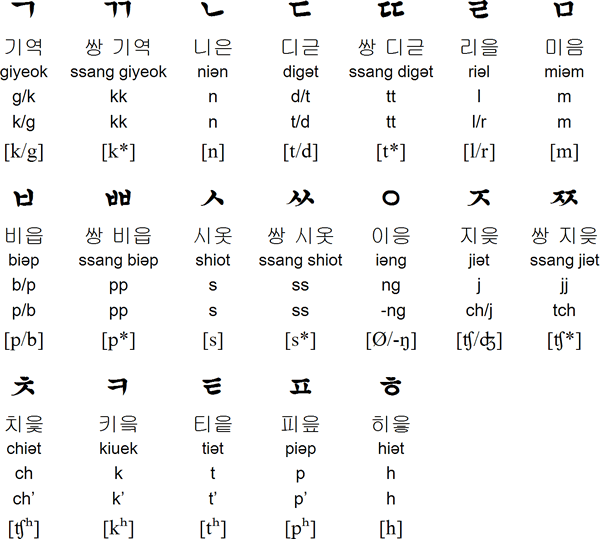
Below is an image from Omniglot. It has each of the consonants, their names in Korean, and then their reading (both in English letters and in IPA.)
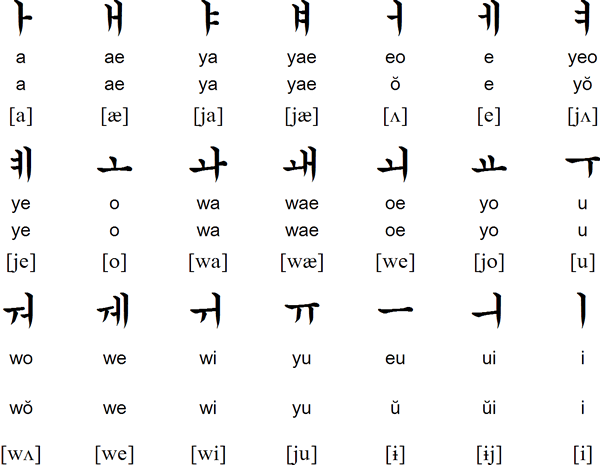
Next we have vowels. (Again, image is from Omniglot.)
Like I said earlier, Korean letters piece together like a puzzle.
For example,
to write hanguk ("Korea" in Korean) you would not write ㅎ ㅏ ㄴ ㄱ ㅜ ㄱ .
Instead, you piece together the letters to make 한국. See how each syllable is put together?
So, how do you know how to piece them together? There are certain "spelling" rules for Korean. They usually depend on the vowel(s) in the syllable.
Here are the rules for constructing syllables.
1 2 like 가 and 이
1
2 like 구 and 요
1 2
3 like 한 and 말
1
2 like 국 and 중
3
1 2
3 4 like 읽 and 찮
In very, very rare occasions you may see a 5 character syllable. This is made by having a vowel blend and three consonants. Like 읧 (the vowel blend ㅢ causes the syllable to have 5 characters. However, this still is basically just like the final 4 symbol rule above.)
Here are some more examples of the rules above.
If there are two characters in a syllable (like ga or mu) then you will write the consonant to the left or above the vowel. So ga = 가 (ㄱ+ㅏ) and mu = 무 (ㅁ+ㅜ)
For the vowels ㅏㅑㅓㅕㅔㅖㅐㅒ and ㅣ the consonant is on the left side
For the vowels ㅗ ㅛ ㅜ ㅠ and ㅡ the consonant is above the vowel.
Final consonants (like theㄴ in 한) come below the initial vowel/consonant-vowel pair.
You can never spell a word beginning with a vowel. So what happens if the word starts with a vowel sound? You use the place holder ㅇ (which is silent at the beginning of a syllable.)
So "an dwae" (no good) is written 안돼 with the place holder preceding ㅏ.
So "an dwae" (no good) is written 안돼 with the place holder preceding ㅏ.
Sometimes the final consonant of one syllable carries over into the following syllable.
For example, 한국 is "Korea" and 한국어 is "Korean" (language). 한국 is read "han guk" so you may assume that 한국어 is read "han guk o." But the final consonant in 국 carries over into 어 so that it is read "han gu go."
This can seem very confusing at first, but you will get used to it and the whole concept will become second nature to you, so don't worry!
There are a few other odd spelling/pronunciation rules but I don't want to go into too much detail here. If you want, please just check out the links about for a more thorough overview. Otherwise, you can probably go on for now and then pick up on the other irregularities as you go along.
Good luck!!

0 件のコメント:
コメントを投稿